by Fern Shaw | Apr 24, 2013 | Water Boilers
… Karl worked tirelessly throughout the week day in and day out in an office in Oughtibridge.
Then the book keeper received the electricity bill and almost blew a gasket. He asked the office manager to conduct some research, specifically to do with using a water boiler (entrance stage right: Winston) vs. using a kettle (Karl already on stage).
The office manager faffed a bit, then did a bit of internet research and came across Winston’s claim to fame on the AquAid website.
Here’s what he discovered:
Q: How can an AquAid Water Boiler save you money?
A: You no longer have to waste time waiting for a kettle to boil.
An average 3kW kettle takes 4 minutes to boil and if all the water in each kettle is actually used, it will produce 5 mugs of hot water.
Scenario: If you have 20 staff that each have 4 hot drinks per day (80 mugs), the kettle will be boiled a minimum of 16 times. It will probably be boiled more often as no-one ever empties it entirely each time they use it. So assuming they do actually use all the water every time, the kettle is boiled 16 times a day
… 16 x 4 minutes = 64 minutes (or let’s say an hour).
If the person, or the people who make the hot drinks are on a salary of £20,000pa and they work a 40-hour week, their hourly wage is £9.62/hour. You are paying £9.62 per day whilst the person waits for the kettle to boil.
£9.62 x 5 days = £48.10 per week
£48.10 x 52 weeks = £2501.20 per year
30 staff, 120 mugs a day = £3751.80 per year
40 staff, 160 mugs a day = £5002.40 per year
And so on …
Energy Consumption:
In terms of actual energy consumption, there is very little difference between a kettle and an AquAid water boiler. In fact, the boiler becomes cheaper to run the more people use it; Unit of Electricity in kW/h = 12 pence (approximately)
Karl the Kettle:
An average kettle is 3kW and takes 4 minutes (0.07 hours) to boil.
So 3kW x 0.07h = 0.21 kWh, 0.21 x 12p = 2.5p
So it costs 2.5p to boil a kettle of water. If all the water in the kettle is used it will produce 5 mugs of hot water.
Taking the same scenario; if you have 20 staff that have 4 mugs a day each, that’s 80 mugs so the kettle is boiled a minimum of 16 times.
So 20 staff, 80 mugs, 16 boils 16 x 2.5p = 40p per day
30 staff, 120 mugs, 24 boils 24 x 2.5p = 60p per day
40 staff, 160 mugs, 32 boils 32 x 2.5p = 80p per day
and so on …
Winston the Water Boiler:
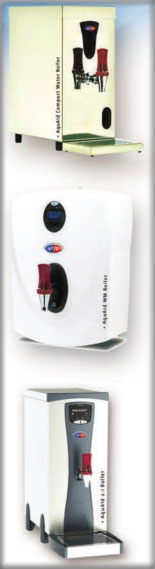
Standby (Idle mode): The electrical consumption of the AquAid 2.1 (5 – Litre) 3kW boiler, whilst on standby is 0.07kW/h, which means it will use one unit of electricity (12p) in 14 hours (0.86p per hour), or 20.6p per day.
Energy usage (when in use): The AquAid 2.1 is designed so that it only boils the water that is used each time. It will run for approximately 30 seconds for each mug of water drawn-off … 1 minute for 2 mugs, 2 minutes for 4 mugs …
So for 20 staff, requiring 80 mugs it will be on for 40 minutes (0.66 hours) throughout the day;
So 3kW x 0.66h = 1.98kWh 1.98 x 12p = 23.7p
Add this to the standby amount of 20.6p per day gives a total of;
For 20 staff, 80 mugs; 44.3p per day
For 30 staff, 120 mugs; 56.6p per day
For 40 staff, 160 mugs; 68.5p per day
So, the story ended with Winston finding a new workspace in Oughtibridge where he kept a staff contingent of 22 very happy with piping hot (but regulated by law temperature wise) water on demand and …
We hear Karl retired to Kilgetty where he snoozes the evenings away and only flips his lid very occasionally during the day when he’s required to boil water for a cuppa ….
And they all lived happily ever after.
by Fern Shaw | Feb 22, 2013 | Water Boilers
298 AD – 306 AD There has been evidence of Romans built large baths with heated water and although these were not individual water heaters, this was a first step towards water heating.
At the height of its power the Roman Empire had conquered most of Europe, including about 1,600 square miles of Britain, its farthest outpost. And in the ruins of Aquae Sulis, the famed spas of Bath, lay the vestige of the rise and fall, and redevelopment of plumbing technique.
By the time the Romans reached Britain in 43 A.D., the curative powers of the hot baths were already part of English legend. Back in 863 B.C., the waters had supposedly healed the leprosy of its Celtic discoverer, Prince Bladud (the father of King Lear, who was to be immortalized by Shakespeare). Bladud founded the city of Bath, and dedicated the springs to the goddess Minerva. The Roman name of Aquae Sulis means “Waters of Minerva.”
Aquae Sulis was at a strategic crossroads for the Roman troops, and the natural hot springs made it a logical setting for the baths of the Emperor Claudius. In addition, the springs produced a constant supply of soothing mineral waters, heated by nature to a temperature of 46.5 C. Important too was that available sources of building stone and lead were close by.
Following Roman custom, Claudius developed Aquae Sulis in the image of the great baths back home, but scaled in size to its smaller location. At that, the complex must have comprised approximately 23 acres.
Fast forward many centuries to London, England, where, in 1868, a painter named Benjamin Waddy Maughan, invented the first instantaneous domestic water heater that didn’t use solid fuel.
Named the ‘geyser’ after an Icelandic gushing hot spring, Maughan’s invention made cold water at the top flow through wires that were heated by hot gases from a burner at the bottom. Hot water then flowed into a sink or tub. The invention was somewhat dangerous because there was no flue to remove heated gases from the bathroom.
Not much more is known about Maughn’s invention; however, his invention influenced the work of a Norwegian mechanical engineer named Edwin Ruud, who, in 1889 was the inventor of the automatic storage water heater.
Ruud emigrated to Pittsburgh where he pioneered the early development of both residential and commercial water heaters.
He founded the Ruud Manufacturing Company which is still in existence today.
1890 to present – Many different designs of water heaters and boilers were invented around the turn of the century, including electric and solar water heaters.
The next blog will introduce us to the modern day water boiler and the differences in terminology, usage and available options..
Frequently Asked Questions
How did the Romans contribute to the development of water heating?
The Romans were pioneers in the development of water heating systems, as evidenced by their construction of large baths with heated water. These baths, although not individual water heaters, were an early step towards the concept of water heating. The Romans utilised natural hot springs, such as those found in Aquae Sulis (modern-day Bath), to create soothing and therapeutic environments.
The Roman baths were not only a place for relaxation but also a centre of social and cultural activity. The strategic location of Aquae Sulis, combined with the availability of building materials, made it an ideal site for the Romans to develop their baths. This early adoption of heated water systems laid the groundwork for future innovations in water heating.
Who was Edwin Ruud and what did he invent?
Edwin Ruud was a Norwegian mechanical engineer who made a groundbreaking contribution to water heating technology by inventing the automatic storage water heater in 1889. His invention allowed for the storage of hot water, making it readily available for residential and commercial use. This innovation marked a significant advancement in the convenience and efficiency of water heating systems.
Ruud emigrated to Pittsburgh, where he further developed his invention and founded the Ruud Manufacturing Company. His work laid the foundation for modern water heaters, and his company continues to be a leader in the industry. Ruud’s invention was instrumental in shaping the future of water heating technology.
How did water heating evolve after the Roman era?
Following the Roman era, water heating technology continued to evolve, with significant advancements occurring in the 19th and 20th centuries. In 1868, Benjamin Waddy Maughan invented the first instantaneous domestic water heater, known as the ‘geyser’. This invention marked a shift towards more efficient and convenient water heating methods, although it had safety limitations.
The late 19th century saw further innovations with Edwin Ruud’s invention of the automatic storage water heater in 1889. This development allowed for the storage of hot water, making it more accessible for everyday use. The 20th century introduced various designs, including electric and solar water heaters, reflecting ongoing advancements in technology and energy efficiency.
How did the invention of the 'geyser' impact water heating?
The invention of the ‘geyser’ by Benjamin Waddy Maughan in 1868 was a pivotal moment in the history of water heating. This device allowed for instantaneous heating of water without the use of solid fuel, making it a more convenient option for domestic use. The ‘geyser’ worked by passing cold water through wires heated by gas burners, producing hot water on demand.
Despite its innovative design, the ‘geyser’ had safety issues due to the lack of a flue to vent gases. This highlighted the need for further advancements in water heating technology. Nonetheless, Maughan’s invention laid the groundwork for future developments, influencing the design of modern water heaters.
What advancements in water heating occurred in the 20th century?
The 20th century saw significant advancements in water heating technology, with the introduction of various designs to improve efficiency and safety. One of the key developments was the invention of the automatic storage water heater by Edwin Ruud in 1889, which gained popularity in the early 20th century. This innovation allowed for the storage and ready availability of hot water, transforming domestic and commercial water heating.
Throughout the century, new technologies emerged, including electric and solar water heaters, reflecting a shift towards more sustainable and energy-efficient solutions. These advancements have made water heating more accessible and environmentally friendly, meeting the growing demand for efficient household appliances.
by Fern Shaw | Feb 18, 2013 | Water Boilers
More about Coffee (English), Koffie (Dutch), Kahve (Turkish), Aahwa (Arabic)
Historical
A French doctor in the 1600’s suggested Café Au Laits for patients, inspiring people to begin adding milk to coffee. Largely through the efforts of the British East India Company and the Dutch East India Company, coffee became available in England no later than the 16th century.
By 1675, there were more than 3 000 coffeehouses throughout England. In 1822 the French were the first to innovate a crude espresso machine. The Italians then perfected this machine and became the first to manufacture it.
Factual
The first webcam was invented at The University of Cambridge to let people know if the coffee pot was full or not.
Coffee beans are actually the pit of a berry, which makes them a fruit.
Coffee beans are graded in various ways. Examples? Kenyan coffees are graded as A, B and C. AA is the best coffee. In Costa Rica, coffees are graded as Strictly Hard Bean, Good Hard Bean, Hard Bean, Medium Hard Bean, High Grown Atlantic, Medium Grown Atlantic, and Low Grown Atlantic. Those coffee beans from Colombia are labelled as ‘Supremo’, ‘Excelso’, ‘Extra’ and the lowest grade, ‘Pasilla’.
Over half of the espresso consumed in the UK is drunk in the South East of the country.
The Italian government regulates espresso because it is considered an essential part of daily life.
Mythical
The ‘Cowboy Coffee’ legend said that cowboys made their coffee by putting ground coffee into a clean sock and immersing it in water heated over a campfire. When ready, they would pour the coffee into tin cups and drink it.
An ancient meme tells of King Solomon entering a town whose inhabitants were all ill. The angel Gabriel appeared and told him to brew up a pot of coffee and distribute it amongst the afflicted citizens who symptoms inexplicably disappeared.
At the treaty of Utrecht in 1713, Louis XIV acquired a Dutch coffee sapling, in exchange for some French lawn sod, that he took home and planted in his Orangery. Myth further says that the next Louis, the XV, personally tended the cuttings by harvesting, roasting and brewing coffee with his own hands for his courtiers.
A Brazilian diplomat, Francisco de Mello Palheta, was to mediate a border issue between French and Dutch Guiana. Myth says Poncho tried to obtain some seeds from the French governor but his request denied so, using another tack, he had an affair with the governor’s wife who placed some of the forbidden cherries and cuttings in a farewell bouquet she gave her lover. Upon his return, myth tells us that Poncho started the Brazilian coffee industry but in reality, Jose Mariano da Conceicao Veloso planted coffee in 1774 using seeds, obtained from a Dutch trader named Hauptman, in the garden of St Anthony’s monastery built in 1608 in what is now Brasília the modern capital.
by Fern Shaw | Dec 12, 2012 | Water Boilers
Coffee is one of those substances that have both good and bad stories written up about it all the time.
What’s the Good skinny? (No, not a skinny, latte, mocha, silly story).
- Coffee does contain antioxidants. But better to not rely on this as your only source of antioxidants. Antioxidants can be found in other yummy sources like blueberries, cherries, & pomegranates as well as a variety of legumes.
- It may have some protective qualities against a variety of cancers and Alzheimer’s disease.
- The caffeine in it is stimulating and releases dopamine (your body’s ‘happy’ enzyme) … which is the main reason why people drink it.
- Boosts your short term memory.
What’s the Bad skinny?
- Mainly because of its stimulating effects, it has been found to aggravate stress and anxiety.
- Other psychological and physical problems including rapid heart rate, higher pulse and blood pressure, and inability to sleep.
- It is also mildly addictive and withdrawal – depending of course, on how many cups you drink in 12 hours or so, can lead to painful headaches.
What one needs to keep in mind when it comes to consumption of any liquids and foodstuffs, is the age old maxim, ‘Everything in Moderation’.
So, whereas a cup o’ Java to kick start your day (hopefully after you’ve eaten something solid) is a good thing; roaring through your day bolstered up on cream or full milk laden coffees or lattés will completely counteract the wonderful effects of coffee and just turn you into a blob. Remember to always counter your cups of coffee with a glass of water as keeping hydrated is vastly important.