by Fern Shaw | Mar 17, 2016 | Water Boilers, water cooler
I’ll admit I’m the world’s biggest wuss when it comes to bathing or showering in cold water. Even when there are scorching hot temperatures, I’ll still opt for a mildly warm shower instead of ice cold. I may slowly turn the hot water tap down during shower but even then, I’d rather not switch off the hot tap entirely.
To be fair, if you live in a region with longer winters and icy cold weather for more months of the year than warm weather, it makes sense to keep that hot tap open, so you’d need to take that into consideration, but when all is said and done, are hot or cold showers better for you and why?
I splish-splashed across the web to find out.
In favour of heat:
- Hot showers can relieve tension and soothe stiff muscles. If you have a powerful showerhead, even better! You can let the hot water work like a mini massage on your shoulders, neck, and back.
- Studies have shown that taking a hot shower can amp up your oxytocin levels and ease anxiety. Anyone working with stress can use more of the love hormone in their life.
- A hot shower also acts as a natural decongestant to relieve cold symptoms, since the hot steam moisturises nasal passages.
- Under the weather and running a slight fever? A hot shower might be what you need to help break your fever and bring your temperature back to normal.
In favour of the cooler option:
- Cold showers – as unbearable as they are – are actually really good for our bodies. Turning your shower cold for the last five minutes can help ‘shock’ your body awake. This instant change in temperature relieves your body of fatigue and increases your mental alertness.
- A ’cooler’ shower (around 20 °C) for two to three minutes once or twice daily is recommended by researchers as a treatment for depression. Just make sure you check in with your doctor before testing this out.
- On the more vain side of the spectrum, cold showers are better for our hair and skin. Where a hot shower can dry things out, cold showers hydrate and help with split ends and dry skin. I also have it on good authority that rinsing your shampoo out with cooler water places less stress on your hair, leaving your hair in a more sleek condition. All of those beautiful sleek looking seals can’t be wrong.
Whichever works for you, a cautionary note – no, I wouldn’t suggest that you filch the company water cooler or boiler to test out the hot or cold shower theory. That water’s for drinking, dear, not bathing.
by Fern Shaw | Mar 11, 2016 | Health and Hydration
As I’m typing this, I’m literally looking (through?) a glass of water waiting for inspiration to strike.
Rather funny, that, considering what the topic of this blog’s about. Have you guessed yet?
*eyes slide back to the glass of water*
*ponder* *ruminate*
*again, eyes go back to the glass of water*
Did you guess? Did you? Did you? Perhaps the title gave it away?
I like the fact that some ways down the line speaking about the benefits of drinking water (and believe you me, when you drink water from one of our water products, the benefits are manifold), I continue to learn something new. Isn’t that marvellous? I happen to think it is!
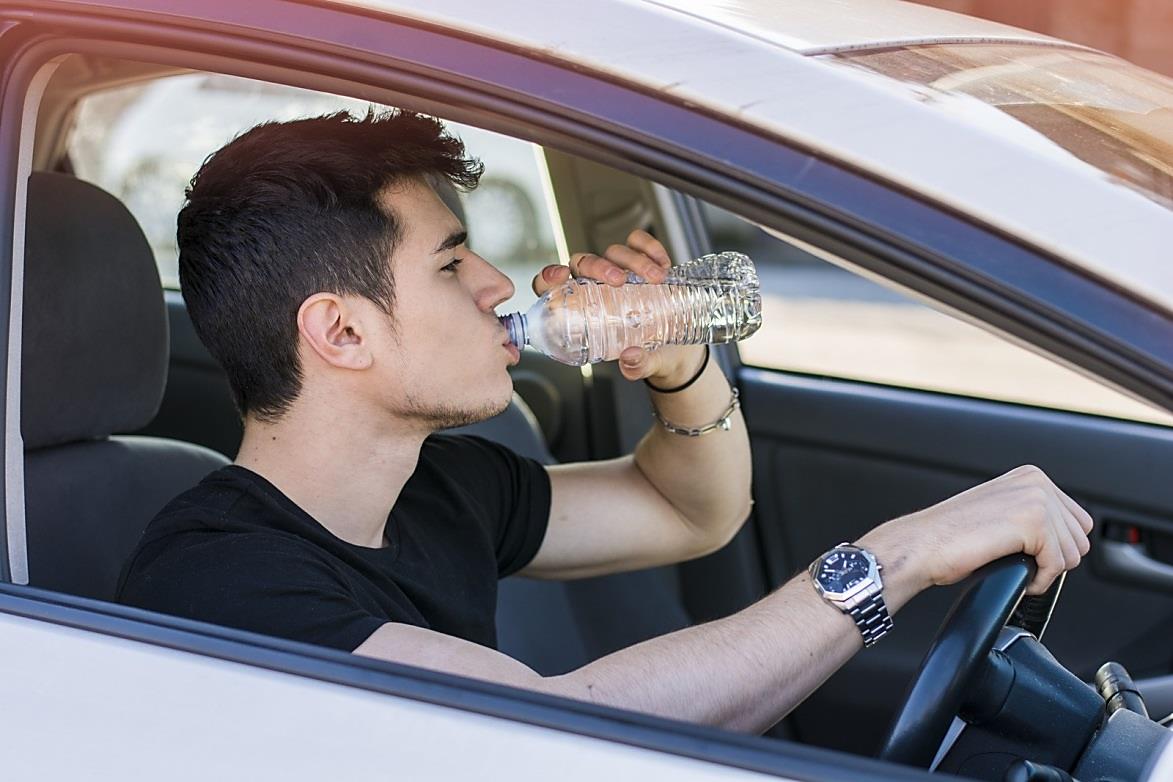
As an example, whereas I’ve covered the length and breadth and depth of hydration; hydration vs. dehydration; how much water to drink; when to drink it; where to drink it; hydration for children; hydration for adult type people; hydration for our elders; etcetera, etcetera. and aside from a mention involving a possible karmic slight accident when driving, I’ve never really been aware or made mention about how vitally important it is that a person driving a car, lorry, any road use vehicle, needs to be sufficiently hydrated in order to operate a vehicle safely.
A driver being hydrated is a thing? Surely not!
Yes, absolutely, driver hydration is a thing. It’s such a thing that there have been definitive studies conducted that establish how vitally important it is for road users to ensure that they keep hydrated while driving.
Why is this?
- Well, as an example, results from these studies have shown that dehydration can occur as easily as having a 1% drop in ydration levels.
- It’s also been proven that a dehydrated driver’s abilities can be as impaired as that of a drunk driver, which in itself is pretty frightening.
- Moreover, the research found that mildly dehydrated drivers are almost twice as likely to make errors on the road when compared with well-hydrated drivers, with dehydrated drivers being more likely to both swerve between lanes and brake late, two of the key causes of vehicle accidents.
As always when I’m learning something, I find information like this fascinating. I’m now more aware of my responsibilities when driving and hopefully, after having read this, now you know too. So, drink up and make sure that your next road trip is a happy and hydrated one, keeping yourself and other road users safe on our roads.

by Fern Shaw | Mar 4, 2016 | Water, water cooler
Does Drinking Water make you Smarter?
Quite simply, yes, it does. How so, you ask (with a healthy lean towards scepticism)? Well, it’s like this:
Every single organ in our bodies relies on being hydrated (i.e. water) to function; this includes the brain.
While you may not realize it, dehydration causes more than just thirst. Water plays an important role in the function of our cells, tissues and organs. Water transports oxygen to the brain, which allows it to communicate important messages to the rest of the body. Even the slightest lack of hydration can reduce your concentration and impair your ability to think clearly and perform well.
Water plumps up our cells, every single last little man jack of them. Think of the benefit of water in terms of when you have dry skin. It becomes shrivelled and crêpe-like the more dehydrated you are. Look at what happens when you rehydrate – your skin becomes noticeably more plumped up, smoothed out and more elastic.
Now picture this example in terms of at a microscopic level – imagine your brain cells lying all flat and sad looking, like a person in a desert, dragging themselves along, trying to function with their body’s resources depleted. They then see an oasis and manage to drink from it. Skip forward in time and that same sad looking, flattened out individual has been transformed into a fully functioning, walking, talking and much happier person all round. The same goes for your cells.
Ergo, our brains depend on proper hydration to function optimally. Brain cells require a delicate balance between water and various elements to operate, and when you lose too much water, that balance is disrupted. Your brain cells lose efficiency.
Years of research have found that when we’re parched, we have more difficulty keeping our attention focused. Dehydration can impair short-term memory function and the recall of long-term memory. The ability to perform mental arithmetic, like calculating whether or not you’ll be late for work if you hit snooze for another 15 minutes, is compromised when your fluids are low.
Over the course of a typical twenty-four hour period, the longest spell most of us go without fluid intake is the six to eight hours we spend sleeping. Sleeping is hardly the kind of activity that you sweat over, but that doesn’t mean you’re not losing water during the night. With every somnolent breath, you expel moisture, and the cumulative effect of a night’s sleep is to dry out.
This may sound like a tome of doom and gloom, but really, if you think about it, it really isn’t. In general, our nearest water source is a small reach or just a few steps away and that’s such good news.
If you want to test the theory, dearie, (I’m not suggesting that you purposefully dehydrate yourself), as you may already know that you probably aren’t drinking enough water daily, or you’re feeling sluggish or don’t have much get-up-and-go; why not try up your water intake? Take your own water bottle to work, replenish from your water cooler often, drink water when you arrive home. You’ll be amazed by the differences and it won’t take too long either if you stick with the ‘hydrate me, myself, I’ campaign.
Before long the only thing that’ll be flattened is that pile of work at your desk and all your paperwork at home. Cheers.
by Fern Shaw | Feb 29, 2016 | Health and Hydration
Two weeks ago I was blathering on about how simple it is to effectively reduce vehicle incidents on the road by instituting driving hydration (and no, this doesn’t mean hydration through drinking your favourite alcoholic tipple and then roaring off down the M1). I tacked the article onto the AquAid FB page and was interested to see the great response it received.
I suppose there are a lot (as in millions, not thousands) of us little humanoids that may take their water hydration very seriously, but there’s perhaps one area where we fall short, and that’s when we get on the road and a driving we will go.
There’s always talk about making sure you’ve had enough rest when you’re about to embark on a road trip or that you’ve eaten well (so you don’t faint while driving and so that your body has sufficient fuel (aha!) for the trip); we do carry on (rightly so) that you shouldn’t be drinking the devil drink before or during driving, but on occasion it seems, we don’t attach enough importance to a very simple solution that will keep most of us bright eyed and bushy tailed whilst travelling and that solution *drumrollllll* is making sure that we’re sufficiently hydrated when driving.
The results from a variety of studies have borne this information out to be true. If you drink sufficient water (alongside with all the other recommendations – sufficient rest, sufficient food, not taking any medication that’ll make you drowsy [so, yes, that cold flu stuff you’re glugging back is a definite NO]) you will be safer (and consequently will keep other road users safer) while driving.
So perhaps this trend is not so much a trend (we hope) but just a rather simple and clever way, borne out by research, to keep you and other road users (we salute you all, those that drive for a living) alert and focused while you criss cross the length and breadth of the country, happily driving and hydrated.
by Fern Shaw | Feb 18, 2016 | Health and Hydration
A while ago I wrote about a slight accident I had while driving a friend’s car, entitled A Funny Thing Happened on the way to the Water Cooler. The blog was all about irony, karma, call it what you will.
I’ve also mentioned day-time fatigue that’s brought on by not drinking sufficient water. You don’t need to take my word for it though, honestly; there are reams and reams of research that clearly indicate the link between performance and hydration.
More recently, I’ve been thinking about the amazing drivers on our roads (said in all seriousness, can you Adam and Eve it) ranging from delivery drivers, cab drivers, bus drivers, and couriers through to emergency services drivers and all of those in-between.
If you think about it, when you’re driving on the road you need to be at your peak, especially if you take extended trips or driving is your job! But in today’s world with more and more vehicles on the road; time being of the essence; working long hours and a number of other contributing factors affecting one’s concentration when driving; it’s not always possible to be fully alert.
But what does keeping hydrated have to do with safe(r) driving, if anything?
Well, extensive research into driving and hydration for one has shown through studies there’s a marked difference in driving performance between a hydrated and dehydrated driver.
It’s also been proven how driving and hydration are vital in reducing vehicle incidents. During this study, it became apparent that, ´… mild dehydration is equal to a 1% drop in hydration levels, the level at which the sensation of thirst is experienced. Previous studies have shown that more severe dehydration reduces cognitive performance even further, thus potentially resulting in an even higher amount of driver errors. GP studies show that up to 60% of the workforce going to work remain dehydrated throughout their working day.’
Food (or water) for thought, methinks. Perhaps it’s a good idea to ensure that you remember to drink enough water prior to setting out on the road, and not just while you’re at home, in the office, or perambulating along. Toot, toot!