by Belinda Ollewagen | Jan 18, 2019 | instant tap, water cooler
Is there such a thing as drinking too much water? Should you decrease your number of visits to the office water cooler? The answer to the first question is yes. And the answer to the second question is no.
Yes, you can drink too much, but it’s an extreme ‘too much’. Runner’s World ran an article a while back entitled busting eight hydration myths, and one of those busted myths was that ‘you can’t drink too much’. If you over-hydrate it can lead to a condition called hyponatremia. As defined by the Mayo Clinic, this ‘occurs when the level of sodium in your blood is abnormally low. Sodium is an electrolyte, and it helps regulate the amount of water that’s in and around your cells. When [hyponatremia] happens, your body’s water levels rise, and your cells begin to swell. This swelling can cause many health problems, from mild to life-threating’.
And why should you not decrease your number of visits to the water cooler? Because of your thirst mechanism, that’s why. Another busted myth is that ‘thirst isn’t a good hydration tool’ – yes, it is. Your body knows what it needs, and when it needs water, it will trigger your thirst mechanism – whether you’re attuned to that trigger or not is another matter of course. So, if you learn to listen to your body and give it what it needs when it signals it, you should be fine. If you’re an athlete and you’re concerned about the amount of water you lose while exercising, knowing your sweat rate and compensating for it, is another way to ensure you receive proper hydration. Doug Casa, Ph.D., professor of kinesiology at the University of Connecticut and COO of the Korey Stringer Institute says the ‘goal isn’t to match your sweat rate, but you should try to get as close as is comfortably possible. For some runners, that may mean replacing two-thirds of the fluid they sweat during the run’. He also adds that you shouldn’t try to drink more than you lose.
And here’s another busted myth ‘caffeine dehydrates you’ – no, it doesn’t. If taken in moderation, coffee or tea can count towards your hydration quota for the day. So, if you feel the need for another hot drink, then head over to the instant taps in your breakout area and make another cup – not only will it aid your hydration levels, but the break will do you good too as both these factors are productivity enhancers!
by Belinda Ollewagen | Dec 29, 2018 | Uncategorized
It’s December and many of us are now preoccupied with festive shopping
and making plans for Christmas. But if you’re reading this, then chances are that
in addition to dreaming about Christmas dinner with all the trimmings, you’re also
one of the lucky few who have access to a natural resource that we all take
very much granted – clean and safe drinking water. For those of us who live in
the modern world, we can’t image a life without easy access to water, but millions
face this harsh reality every day – all year round.
According to the United Nations Educational, Scientific and Cultural Organization (UNESCO)these are some of the staggering statistics:
- Up to 90% of wastewater in developing
countries flows untreated into rivers, lakes and highly productive coastal
zones, threatening health, food security and access to safe drinking and
bathing water.
- Over 80% of used water worldwide is not
collected or treated (Corcoran et al., 2010).
- The provision of improved sanitation and
safe drinking water could reduce diarrhoeal diseases by nearly 90% (WHO,
2008a).
- Human health risks are without doubt the
major and most widespread concern linked to water quality. Each year
~3.5 million deaths related to inadequate water supply, sanitation and
hygiene occur, predominantly in developing countries (WHO, 2008b).
- Diarrhoeal diseases, often related to
contaminated drinking water, are estimated to cause the death of more than
1.5 million children under the age of five per year (Black et al.,
2010).
- An important share of the total burden of
disease worldwide, ~10%, could be prevented by improvements related to drinking
water, sanitation, hygiene, and use of environmental management and health
impact assessments.
While many organizations across the world work tirelessly to alleviate some of the suffering, we still have a long way to go. But by working towards a common goal we can make a difference, which is why in 2010 AquAid founded the Africa Trust to help make an impact and create sustainable projects that empower the less fortunate. When you choose AquAid as your preferred water cooler supplier, you not only gain access to an extensive range of high-quality products, but you also help to bring fresh and safe drinking water to thousands of impoverished people every day.
Water
crises may exist all year round, but to date – and with your help – AquAid have
donated in excess of £14 million and helped bring water to more than 2.5
million people! Eradicating the problem may seem an impossible task, but with
each step, we help another person every single day.
by Fern Shaw | Dec 25, 2018 | Uncategorized
A recent blog titled ‘And a Water Rich Pear Tree’ was actually about pears and how they’re such a water rich fruit (go and have a read, you’ll be glad you did). This blog, however, is actually about the origins of the rather wonderful (some would say long-winded) Twelve Days of Christmas.
According to Wiki: “The Twelve Days of Christmas” is an English Christmas carol that enumerates in the manner of a cumulative song a series of increasingly grand gifts given on each of the twelve days of Christmas (the twelve days that make up the Christmas season, starting with Christmas Day). The song, published in England in 1780 without music as a chant or rhyme, is thought to be French in origin.
In the interests of brevity, here are the opening bars:
On the first day of Christmas my true love sent to me
A partridge in a pear tree.
On the second day of Christmas my true love sent to me
Two turtle doves
And a partridge in a pear tree.
On the third day of Christmas my true love sent to me
Three French hens,
Two turtle doves,
And a partridge in a pear tree.
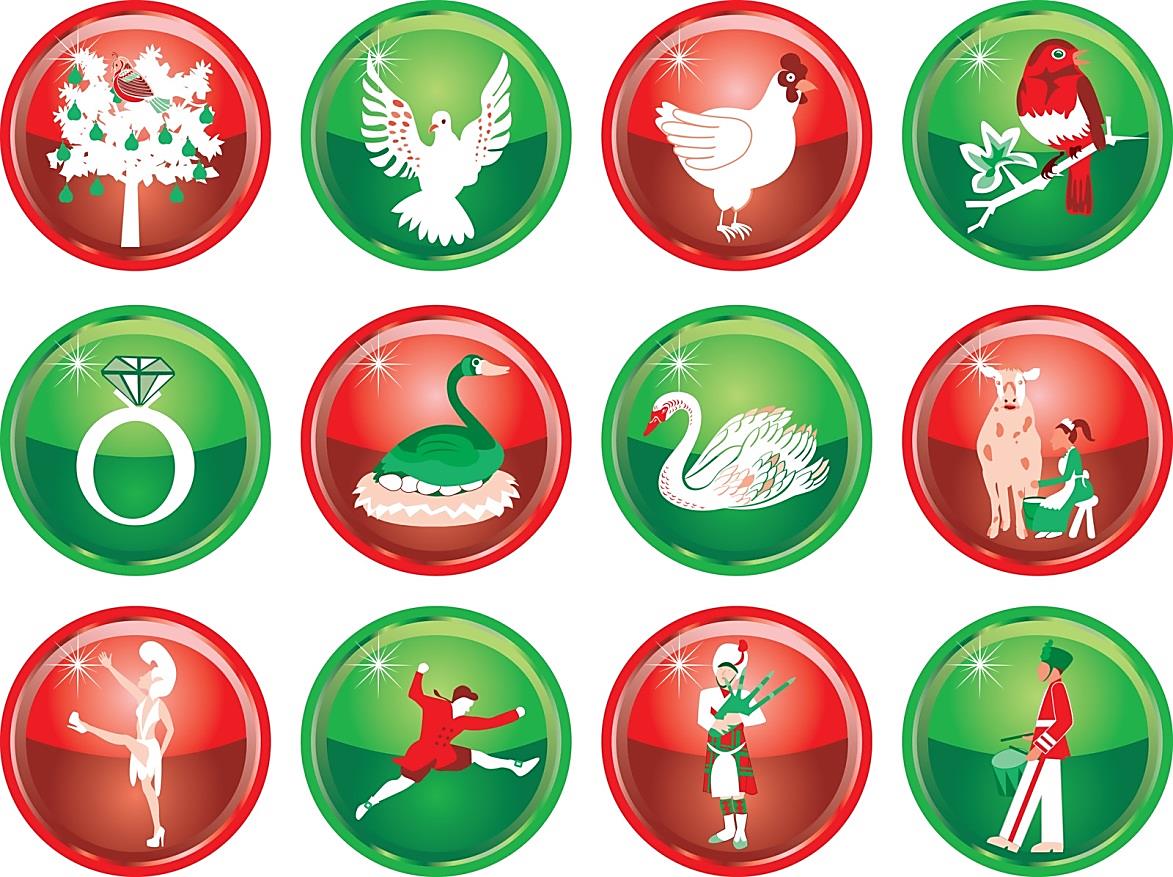
The song is then added to (refer to the above image for the sequence), always returning to the initial bars.
You may be wondering what this has to do with your water cooler – in fact, with water in general. It’s simple, really – we’re all aware of the term ‘water cooler humour’ – which generally refers to the habit where those worker bees who gather at their dispenser for a short break to refresh their water and top up their water bottles, and use this time to swap stories, compare notes and generally catch up on what’s been happening since everyone last got together (since the last water cooler break, that is).
Now that we’re racing towards Christmas and we’re all of good cheer, but we’re all a little tired after a big year filled with conkers such as ‘to Brexit or not to Brexit’ perhaps we’re running out of steam, or cheery topics – this is where this song comes in. You can amaze and delight your colleagues with your knowledge; you can retrieve the song on your mobile and who knows, begin a rousing rendition at the water cooler break station, which might just get everyone in more of a festive spirit (or might not, either way, we won’t be accepting any responsibility if the water cooler break goes south).
However you choose to your water cooler break, remember to stick with the original quest – to replenish your water all the better to keep your merry little self hydrated this festive season.
P.S. If you don’t currently have a water cooler where you can gather to chat to your colleagues, contact us at AquAid – we have 20 years’ experience in the provision of the right water dispenser to meet your requirements.

by Fern Shaw | Dec 25, 2018 | Uncategorized
For many, December can mean a time of excess and overload, although often it may not be intentional. It’s easy to be caught up in the festivities whether it’s the year end work functions or just a general letting the hair down after a long year.
When it comes to festive drinking though, there are ways to keep it fun and jolly and still maintain a healthy level of hydration.
Hot chocolate: Yes, hot chocolate is full of sugar, but it also consists of hot water (you can even make your hot chocolate at work using your AquAid Water Boiler – bonus!) and chocolate! And as we all know, chocolate (in moderation) is good for you.
Spiced hot drinks: We’re not going to fall into the trap of suggesting that glühwein or mulled wine is good for you (we’re rather clever little elves are we), but the spices and fruit that are part of these hot drinks can be used with great healthy hydrating effect without being steeped in alcohol. Sleigh across the internet, there are more hot spiced drinks than you can shake a stick of Blackpool rock at.
Cool drinks: If you’ve pledged to keep it tidy, alcohol wise, this Christmas, why not opt for mocktails? They’re fun, fruity, tasty and good for you. For these though, whereas you can draw your fresh drinking water from your water cooler, it’s probably best not to do your mixings at the water cooler station. Rather use the kitchen or bring your mixings from home to add to your water. Think cinnamon pear, orange pomegranate or apple cinnamon pomegranate.
Should you opt for the alcohol rich festive cheer, remember the general rule of thumb: match each alcoholic drink with a drink of water.
On this cheery note, we like to take the opportunity to wish you all a wonderful festive season and a very Merry Christmas from all of us at AquAid.
by Fern Shaw | Dec 24, 2018 | Uncategorized
Even
though pears (or pear trees at least) are immortalised in that classic Christmas-time
song involving a partridge and a stream of nerve-wracking repetition, the
actual pear is an oft overlooked fruit this time of year. – and they certainly
shouldn’t be. Here’s why:
Pears rank high on the water-rich fruit
list, with a water content of some 84%. But that’s not the only reason we
should look to pears to increase our perhaps lax winter drinking water
habits – they are also highly nutritious.
Pears help lower cholesterol – they contain
heart-healthy soluble fibre, a nutrient that can reduce the absorption of LDL
or ‘bad’ cholesterol into the bloodstream. This means they’re good for heart health too.
They
boost the immune system – when you’re feeling a bit
under the weather, or it feels like you’re coming down with a cold – eat a
pear. They are high in vitamin C and
other nutrients that boost the immune system.
Digestive aid – the same fibre found in pears that helps lower cholesterol also aids
digestion. In nice terms, pears essentially keep our plumbing working
properly. You can thank the pectin,
a component of dietary fibre, in them for that one.
They’re hypoallergenic – Pears are a nutritious option for those with food sensitivities –
without any adverse effects.
Super hydrating – we all recognise pears for their incredible juiciness. That sumptuous
feeling when you bite into a juicy pear is because they boast a high water
content.
Whereas you might be tempted to follow the
rather less healthy pear eating route – glazed pears, pear tarts etc. you’ll
get most of the goodness from raw pears, eaten unpeeled – most of the benefits
are locked into the skin.
If circumstances are having you neglect
your water
cooler water refill this winter (although we recommend you don’t), at least
you’ll have back-up – in the form of the healthy, delicious, water-rich pear.