by Fern Shaw | May 17, 2024 | instant tap, water cooler, water cooler, Water Coolers
In Part I about skipping lunch while working, we were all about bad nutrition and productivity and skipping lunch. In this session, the debate continues with mentions of the (for some) dreaded broccoli, superfoods and eating well at work.
Two journalists battled it out; one had spent time working in France, where lunch was always taken away from one’s desk. The other said that she would far rather power through her lunch break and have her sandwich at her desk as it would give her more time after work to spend with her family.
Having lunch away from your desk is the way to go, according to studies at the University of California. Taking the time out of your work environment gives your brain a breather and allows your brain to ‘power up’ and go back to work refreshed and ready for the next haul. Sitting at your desk doesn’t allow for that brain refresh. I would imagine it’s similar to taking a power nap, which does work.
Superfoods
*In the nineties, it was all about organic food. Then along came the concept of ‘superfoods’, a term used to describe foods that are supposedly really good for you. But it turned out to be more of a re-branding exercise for otherwise mundane supermarket produce, like berries for example. And if you ask a scientist, the term superfood means something completely different. It’s used in academia to refer to calorie-dense food, like chocolate (aha!).
Broccoli
Apparently, the little green forest trees (as I like to call them), have been shown to help the immune system to clean harmful bacteria from the lungs. A compound found in the vegetable is now being trialled as a treatment for people with lung disease.
Eating well
When surveyed by researchers from Nottingham University, staff at the UK’s National Health Service said they felt they had a responsibility to set an example for healthy eating at work. But the American Journal of Public Health found that for healthy eating habits at work to take any effect, workers’ families also had to get on board. What people eat at work is linked to their overall lifestyles and attitudes to nutrition.
I must say I do like the can-do attitude of the people at the NHS. Overall, I think it is important, as your working day takes up a lot of your hours awake (bar those power naps), to make sure that the powers-that-be in your work environment focus on your well-being too. Are there kitchen facilities at your workplace?
Is there a water cooler? Instant Tap? A hot water drinks dispenser?
Some type of sip and feast designated area?
If not, perhaps it’s time to have a chat with your employer and point out the clear benefits between nutrition, good hydration and productivity.
source*: an article in Quartz.
source**: an article in the New Scientist

by Fern Shaw | May 14, 2024 | water cooler, Water Coolers, water dispenser
There’s no avoiding it. Work an eight-hour (or longer) day and you’ll have to stop to eat at some point. Be it a questionable sandwich or a lavish lunch, workers need grub. But what should you eat to achieve maximum results? And is skipping lunch to reply to those e-mails really such a bad thing? In this two-part series, we have a look at both sides.*
Eating in the office canteen is good for you. In Finland, at least.
The Finnish have done a lot of research into workplace eating habits. One study by the Finnish National Institute for Health and Welfare found that workers who ate in office cafeterias, compared to those who brought in packed lunches, were eating more fruit and vegetables. This has a lot to with the fact that in Finland, food provided in canteens must meet national nutritional guidelines.
To be sure, the wisdom of eating in a canteen does depend on the quality of what’s on the menu. Staff interviewed at Barnsley Borough Council in London described the food in their cafeteria as ‘stodgy’ and more suited to those performing manual work.
Skipping lunch is bad for you.
As explained in his book about workplace eating habits, Christopher Wanjek found that workers who skip lunch are more stressed, less productive and only end up snacking in the afternoon anyway.
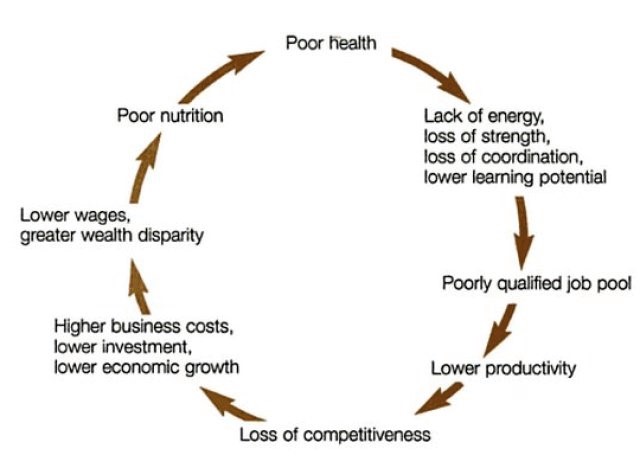
The endless cycle of bad nutrition and low national productivity.
Poor eating choices affect productivity. In fact, it causes this shame spiral:
There’s a lot that has gone into this debate. In Part II, we’ll thrash this out further. For now, at least one thing is crystal – keeping yourself hydrated at work can only be good for you.
While we wait for the next instalment, remember to repeatedly recharge your water glass or water bottle using your desktop water dispenser or zeroing in on your floor-standing water cooler.
*source: from an article in Quartz.

by Fern Shaw | Mar 20, 2024 | Hot Water Taps, instant tap, mains fed water cooler, water cooler, water cooler, Water Coolers
The theme for World Water Day, 22 March 2024, is ‘Water for Peace’, which focuses on the critical role water plays in the stability and prosperity of the world.
According to UN-Water, ‘when water is scarce or polluted, or when people have unequal or no access, tensions can rise between communities and countries.
More than three billion people worldwide depend on water that crosses national borders. Yet, out of 153 countries that share rivers, lakes and aquifers with their neighbours, only 24 countries report having cooperation agreements for all their shared water.
By working together to balance everyone’s human rights and needs, water can be a stabilising force and a catalyst for sustainable development.’
The good news is that even if you are not directly involved in this year’s World Water Day, as an AquAid customer, you are helping with the continued implementation of sustainable water projects which help provide potable water, water to grow crops and water for productive use for thousands of communities in water poor regions across Africa. These safe water resources, often built in areas accessed by multiple communities, can help to minimise conflict which may arise from insufficient and unsafe water sources.
With each mains water cooler installation and every bottle of water purchased, we donate a portion of that revenue to the charities we have supported for over twenty-five years: Christian Aid, since 1998 and The Africa Trust – an AquAid founded charity – since 2010.
If you are not yet an AquAid customer but appreciate how we work, we will be more than happy to help introduce you to our range of water dispensers, bottled water coolers, hot water boilers and Instant Taps offering hot, cool or chilled water.

by Fern Shaw | Mar 14, 2024 | water cooler, Water Coolers
It’s World Sleep Day this week. The day is dedicated to bringing attention to the vital role adequate sleep plays in maintaining health and well-being. With millions of Britons suffering from a similar ailment – an inability to get enough sleep – we look at how good hydration can assist in creating better sleep.
Does drinking enough water aid our ability to sleep better?
The short answer is, yes it does.
How so?
During deep sleep, your body works to repair muscle, organs and other cells. Chemicals that strengthen your immune system start to circulate in your blood. If you are properly hydrated, your body is better fuelled, more easily able to effect these vital repairs.
How soon before bed should you drink water?
The rule of thumb is not to drink lots of water (or any liquids) at least two hours before bed. Ideally the bulk of your water consumption should be during the day or well ahead of bedtime.
Although dehydration can occur during sleep, this is easily repairable by drinking water upon waking.
What is the drinking water after bedtime conundrum?
Drinking a small amount of water before bed can keep you hydrated overnight, but too much and you’ll disrupt your sleep cycle with trips to the bathroom.
Having access to a constant supply to refreshing drinking water throughout the day is essential to ensure you can easily maintain sufficient hydration. Which is yet another reason to make sure you visit your water cooler regularly during the day, keeping yourself properly hydrated and well prepped for a good night’s rest.
by Fern Shaw | Feb 27, 2024 | water cooler, water cooler
At AquAid Water Coolers, we’ve been in the business of water provision for over 24 years, supplying a wide range of high-quality water coolers and drinking water to customers throughout the UK.
We value our customers as we understand that they are the backbone of our business, enabling us to grow from our humble beginnings in 1998 to now, one of the UK’s largest water cooler suppliers.
Just as important to us, and an integral part of our business ethos since we began, is our commitment to helping those in need. In this manner AquAid has, to date, donated over £20 million to charity and helped more than three million people secure sustainable safe water resources.
Another organisation (and valued customer) committed to protecting their clients is Frontline Safety UK.
We recently invited them to take part in a charity initiative: this involves the building of a water well (known as an Elephant Pump) which enables a community in Africa direct access to safe drinking water. This pump building program is instituted by an AquAid founded charity – The Africa Trust – that has, since its inception in 2010, built more than 8,000 such pumps throughout sub-Saharan Africa, providing potable water to more than two million people.
During our communications about this initiative, we found out a little more about Frontline Safety UK:
‘At Frontline Safety, we’re proud to align ourselves with AquAid’s mission of making a positive impact beyond business operations. As a leading provider of safety equipment and solutions in the UK, our commitment to community welfare and sustainable development runs deep. Collaborating with AquAid’s charity initiative resonates with our ethos of corporate responsibility and social contribution.‘ ~ Callum Brown – Digital Marketing & Website Executive
We are delighted they have agreed to partner with us on this very worthwhile cause and look forward to being able to present them with a photo of their pump, a certificate and a letter of thanks once the pump has been built and named.

by Fern Shaw | Feb 27, 2024 | water cooler, Water Coolers
While the current cold weather seems wont to extend its icy hold over the UK our instinct may be to hydrate less, this is a mistake.
When it’s cold, we may tend to think that we dehydrate less easily than we do when it’s warm, but this is often not the case. *What occurs is the body’s thirst response diminishes, by as much as forty percent, even when we’re already dehydrated. This happens due to the body’s blood vessels constricting when cold in order to prevent blood from flowing freely to the extremities. This enables the body to conserve heat by drawing more blood to its core. Because of this, the body is fooled into thinking it has properly hydrated, e.g. you don’t feel as thirsty and your body doesn’t conserve water. What may also occur is as you are less inclined to drink more water voluntarily; your kidneys don’t receive the signal to conserve water and urine production increases, again potentially leading to dehydration.
This increased urine production and reduced thirst response are only two of the contributing factors. Some others include:
- When wearing multiple, heavy layers of clothing, our bodies have to work between ten and forty percent harder. As such, we sweat more and lose more fluid.
- We also experience increased respiratory loss. This is when you lose water vapour through your breath, which means there is an increase of fluid leaving your body.
- The fact that sweat evaporates more quickly in cooler temperatures means your body is, once again, fooled into thinking you need less fluid.
The simplest method to counteract cold weather dehydration is to keep an eye on how often you drink water, much like you would during warmer weather.
If you usually make regular trips to replenish your water container from the work water cooler, carry on doing so. Should you work from a home office or remote location, set a repeat alarm on any tech gadget you use.
If chilled water is too much to consider drinking, drink ambient (indoor) temperature water.
If you can only consider drinking piping hot water from your hot water boiler, that’s fine, however, try to balance out each hot drink with a drink of cool water and keep yourself well hydrated, whatever the weather.
*source: First Aid For Life