by Fern Shaw | Jul 5, 2013 | Health and Hydration
Cereal. I personally have never been a fan. Bo-ringggg. The name itself conjures up an image of sleepy-eyed morning zombies sitting at the kitchen counter cud chewing their way through their morning repast.
I’ve always been more of the ‘Breakfast? Pah! Breakfast is for sissies’ type of roller. Me, I chug-a-lug 2 mugs of industrial strength coffee, come ten o’clock, I’m invincible. We won’t mention that come two thirty-ish, you’d invariably find me in a little heap draped around the water cooler, sobbing piteously without enough energy to raise my Despicable Me water bottle to the spigot.
Anyhow, I digress. Consequently, as with most bad eating habits, there came a point when my poor digestive system rebelled. Quite painfully. So I realised I had to woman up and start eating breakfast. But not the full Monty type of breakfast; bacon, eggs, tomatoes, toast, etceteraa, but … cereal type of breakfast.
I remembered in the mists of time that I had once tried muesli. Not the sugar coated, candy type of muesli, but rolled oats, dry as the desert and enough seeds and nuts to keep an aviary of seed cracking birds happy for a week type of muesli.
Apparently, the muesli I was after is called Bircher’s Muesli:
Etymology (fancy term for the origin of a word and the historical development of its meaning.)
Originally known in Swiss German as Birchermüesli or simply Müesli, the word is an Alemannic diminutive of Mues which means “puree” or “mash-up.” See, enuff said – “mash-up” says it all!
History
Muesli was introduced around 1900 by the Swiss physician Maximilian Bircher-Benner for patients in his hospital, where a diet rich in fresh fruit and vegetables was an essential part of therapy. It was inspired by a similar “strange dish” that he and his wife had been served on a hike in the Swiss Alps. Bircher-Benner himself referred to the dish simply as “d’Spys” (Swiss German for “the dish”, in German “die Speise”). Muesli in its modern form became popular in Western countries starting in the 1960’s as part of increased interest in health food and vegetarian diets. Traditional muesli was eaten with lemon juice and not milk. Goodness gracious, lemon?
Packaged muesli is a loose mixture of mainly rolled oats together with various pieces of dried fruit, nuts, and seeds. It commonly contains other rolled cereal grains such as wheat or rye flakes as well. There are many varieties. This dry packaged muesli can be stored for many months. It can be served quickly after mixing it with milk, yogurt, coffee, hot chocolate, fruit juice, or water.
So, if you, like me, have been given a serious health slap by your very own body, take a page out of my book. Skip the caffeine charging coffees on an empty stomach; pack your moo-oo-sli into your ‘lunchbox’ every morning and meet your workmates around the water cooler, (so that you have company while you cud chew your way through your brekkie), pour water into your breakfast of champions and you’re set for the day.

by Fern Shaw | Jul 5, 2013 | Health and Hydration, water cooler, Water Coolers
In short, no.
But the following all contain water (clever that), so is it a conundrum? Water is found in most liquids, antioxidants are found in some of those liquids so whereas an antioxidant can be water, water can’t be an antioxidant. Excuse me, I have to sit down, my brain is hurting. (Clearly, not enough water). Okay. So, not a conundrum, it’s something else. Moving swiftly along!
What are antioxidants?
Antioxidants are phytochemicals, chemicals found in plant foods. In our bodies, antioxidants protect healthy tissues from “oxidants,” also called free radicals. Over time, free radicals can damage cells and cause disease. Antioxidants are like microscopic police officers who seize these bad guys that plan to harm our cells.
Which do you crave in the morning—a cup of java or a spot of tea? Popular belief labels tea as a health drink and coffee as bad. Not so! Mounting evidence suggests that both are good for you because they’re brimming with antioxidants.
All teas contain a group of antioxidants called flavonoids.
Tea is the second most consumed beverage in the world, next to water. Green tea is especially popular in Japan and China.
According to studies carried out tea drinkers take in 20 times more flavonoid antioxidants per day than tea non-drinkers.
Experts say tea provides as many disease-fighting flavonoids as fruits or vegetables. Many brands of tea list antioxidant and caffeine content (in milligrams per serving) right on the box.
What about fruits and veggies?
Since coffee and tea are high in antioxidants, can they replace fruits and vegetables in our diets? Absolutely not! Fruits and veggies supply fibre, essential vitamins and minerals, plus a variety of different antioxidants that promote good health.
A word of caution
Plain coffee and tea are healthful, calorie-free beverages. Be careful how much cream, sugar, and flavourings you dump into your cup. Just 1 tablespoon of cream and 2 teaspoons of sugar can add up to 80 calories and 6 grams of fat. Squirt in flavoured syrup, pile on whipped cream, and your once-healthful drink becomes a rich dessert.
Which is better—coffee or tea?
Science can’t really say one is superior to the other, so fill your mug with whichever brew you like. To benefit from both sets of antioxidants, try this: drink one or two cups of coffee in the morning, then enjoy tea throughout the day.
For all your cool and hot water requirements for said antioxidant drinks, remember that AquAid have all that you need. We supply bottled water coolers; mains-fed water coolers; desktop coolers; water boilers and in-cup drinks.
If what you require isn’t listed here, drop us a mail, we’ll be more than happy to provide you with a solution.
by Fern Shaw | Jun 7, 2013 | Charity
As you may have gathered by now, I like to think of myself as a bit of a card carrying clown-arounder, not taking ‘stuff’ too seriously and always looking for the pun, the sarckie (that’s sarcasm to you) the silly, but ….. there are some days when all the malarking around is just supressed in an instant.
That would be today.
Here’s why:

I have always been rather shine-my-lapels to work with a company that not only has a work ethic but it sticks to it and even more so that AquAid has an ethic towards sustainable charities and sticks to that and, and, and … but, when I read something like this, honestly, I put paid to a week of good hydration habits in 10 minutes flat. Leaking eyes, super attractive puffy eye surrounds, weird keening noises, you know the drill.
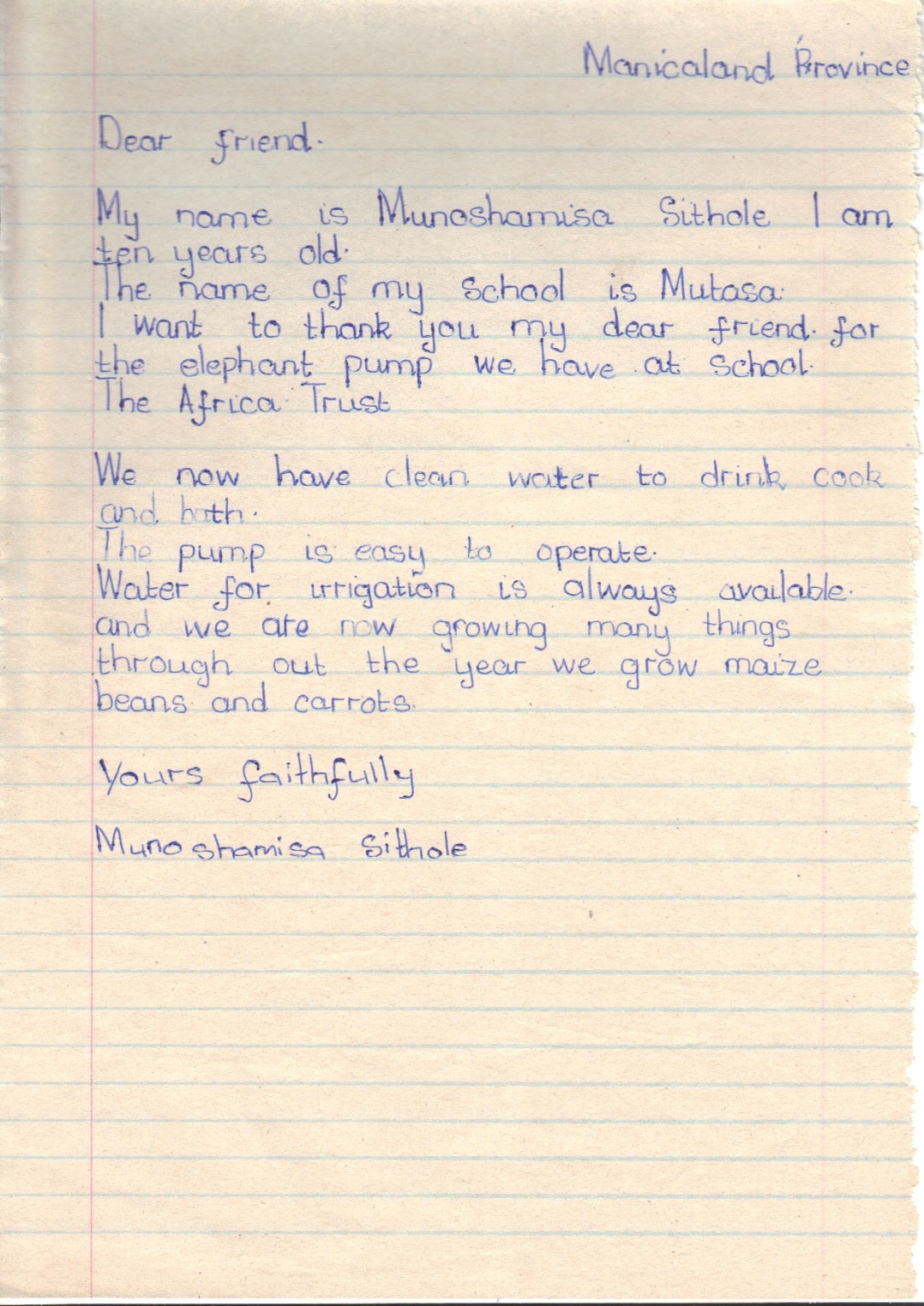
Now before I short circuit my keyboard from all the blubbing, let me elaborate about this magical water producing letter:
- It is written by a 10 year pupil who attends a school in a rural region of Zimbabwe.
- The Elephant Pump was built by a team and people in the local community.
- The team will have been trained by The Africa Trust.
- The Africa Trust is one of the charities that AquAid supports.
- AquAid founded The Africa Trust together with Ian Thorpe, CEO of The Africa Trust and inventor of The Elephant Pump.
- Ian Thorpe developed the pump after having worked as a teacher in remote African rural areas and seeing how communities had to walk for many miles each day just to get drinking water.
So, all of this eventually led to this rather remarkable letter and I’m c for seriously delighted to say that there are more letters like this because there are more wells that that have been built.
Fab-u-lous! *snif* Online casino slots | Business | Article Point- Casino Slots
by Fern Shaw | Jun 7, 2013 | Health and Hydration
I always remember my mum and her ‘home-made’ remedies – most of which I disliked intensely, as they involved gaggingly horrible ingredients like molasses and cod liver oil (I kid you not) and other such horribles.
Now, as a fully-fledged adult (as I would have you believe) I realise that my mum was (and is) a very wise and advanced individual when it came to such good health benefits.
Apart from the whacking great tablespoonful of said clo & m (or clom) every morning, part of my mum’s morning ritual would be the juice of half a lemon, freshly squeezed, in a glass of hot water. When it looked like a cold might be coming on, a tablespoon of honey (which we’ll chat about in another blog) would be dissolved in with the lemon water.
Here’s the sweet and the sour of it:
- Boosts your immune system: Lemons are high in vitamin C, which is great for fighting colds. They’re high in potassium, which stimulates brain and nerve function. Potassium also helps control blood pressure.
- Balances pH: Drink lemon water every day and you’ll reduce your body’s overall acidity. Lemon is one of the most alkaline foods around. Yes, lemon has citric acid but it does not create acidity in the body once metabolised.
- Helps with weight loss: Lemons are high in pectin fibre, which helps fight hunger cravings. It also has been shown that people who maintain a more alkaline diet (see #2) lose weight faster.
- Aids digestion: Lemon juice helps flush out unwanted materials. It encourages the liver to produce bile which is an acid that required for digestion. Efficient digestion reduces heartburn and constipation.
- Is a diuretic: Lemons increase the rate of urination in the body, which helps purify it. Toxins are, therefore, released at a faster rate which helps keep your urinary tract healthy.
- Clears skin: The vitamin C component helps decrease wrinkles and blemishes. Lemon water purges toxins from the blood which helps keep skin clear as well. It can actually be applied directly to scars to help reduce their appearance.
- Freshens breath: Not only this, but it can help relieve tooth pain and gingivitis. Monitor this, as too much citric acid can erode tooth enamel.
- Relieves respiratory problems: Warm lemon water helps get rid of chest infections and halt those pesky coughs. It’s thought to be helpful to people with asthma and allergies too.
- Prevent kidney stones: Drinking one half-cup of lemon juice every day raises citrate levels in the urine. Studies have shown that this could protect against calcium stones in the kidney.
- Potassium power: Bananas aren’t the only way to get a big helping of potassium in your system. In addition to vitamin C, lemons offer 80 milligrams of this mineral that helps your body stay strong and nimble.
If you’re one of those workaholics who arrives at work pre-dawn and you haven’t yet mastered the art of carrying your kettle with you, never fear. With AquAid’s range of water coolers, water boilers and in-cup drinks range, all you’ll need to stock up on is a lemon. Pour yourself a mug / thick glass of hot water (water from source I’ll have you know) add lemon (or squeeze, who needs a stress ball) mix and drink. Lemon power to you!
by Fern Shaw | Jun 3, 2013 | Health and Hydration
There are so many beliefs, myths and legends about this life giving force, it’s not difficult to see why blood has taken on an extremely mysterious ‘persona’ about its capabilities!
Facts
Let’s demystify this rather incredible fluid.
- Human blood is 83% water.
- The average adult man has about five to six litres of blood in his body, while the average woman has about four.
- Your blood makes up about 7% of your total body weight.
- About 95% of the body’s blood cells are made in bone marrow.
- There are approximately 1 billion red blood cells in two to three drops of blood.
- There are three types of blood cells: Red blood cells, white blood cells and platelets, all of which float around in plasma. The blood that you donate can be separated into these constituent parts.
- Whole blood has a shelf-life of 35 days. Red blood cells last 42 days, platelets only five days and plasma up to one year.
- The most common blood type is O positive, while AB negative is the most rare. People with AB blood can receive any kind of blood from a donor, while O negative blood can be given to anyone.
- Half your body’s red blood cells are replaced every seven days.
Blood colour
Think all blood is red? Not so.
Human blood is red. This is because of the iron content.
Crabs have blue blood. Not because they are crustacean royalty, but because their blood contains copper.
Leeches have green blood. This is from the chlorocruorin (a dichroic red-green respiratory protein).
Beliefs
Then there’s the other side of the coin (or platelet), fact and fiction mixed in:
Ancient Greece
The Ancient Greeks believed that the blood of the gods, ichor, was a mineral that was poisonous to mortals.
Blood was associated with air, Spring time, and with a merry and gluttonous personality in classical Greek medicine. It was also believed to be produced exclusively by the liver.
Indigenous Australians
In many indigenous Australian Aboriginal traditions, ochre — particularly red — and blood, considered Maban, are applied to the bodies of dancers for ritual.
Blood is also used to fasten the feathers of birds onto people’s bodies. Bird feathers contain a protein that is highly magnetically sensitive.
Lawlor (Robert Lawlor, mythographer) comments that blood employed in this fashion is held by these peoples to attune the dancers to the invisible energetic realm of the Dreamtime. Lawlor then connects these invisible energetic realms and magnetic fields, because iron is magnetic.
Chinese and Japanese Cultures
In popular Chinese culture it’s often said that if a man’s nose produces a small flow of blood, it signifies that he’s experiencing sexual desire.
This frequently appears in Chinese-language and Hong Kong films as well as in Japanese culture parodied in anime and manga. Characters, mostly males, will often be shown with a nosebleed if they have just seen someone nude or in little clothing, or if they have had an erotic thought or fantasy.
The belief is based on the notion that a man’s blood pressure will spike dramatically when aroused.
Indo-European Paganism
Among the Germanic tribes – such as Anglo-Saxons and Norsemen – blood was used during their sacrifices. The blood was considered to have the power of its originator, and after the butchering the blood was sprinkled on the walls, on the statues of the gods, and on the participants themselves.
The act of sprinkling this blood was called ‘bleodsian’ in Old English, and the terminology was borrowed by the Roman Catholic Church becoming to bless and blessing.
The Hittite word for blood, ‘ishar’ was a cognate to words for ‘oath’ and ‘bond.’
Water is such an incredibly important, literally life giving external source to one’s life blood for a number of reasons:
- Our blood, which contains a lot of water, carries oxygen to all the cells of your body.
- Without oxygen, those tiny cells would die and your body would stop working;
So, water and blood are inextricably linked in keeping you going, keeping you healthy and keeping your blood cells plumped up.
Remember – 8 glasses a day. Whether at home; at school; at the office or exercising.